
AntiGravity 2 Lost the Plot From AI IDE to Just Another Agent
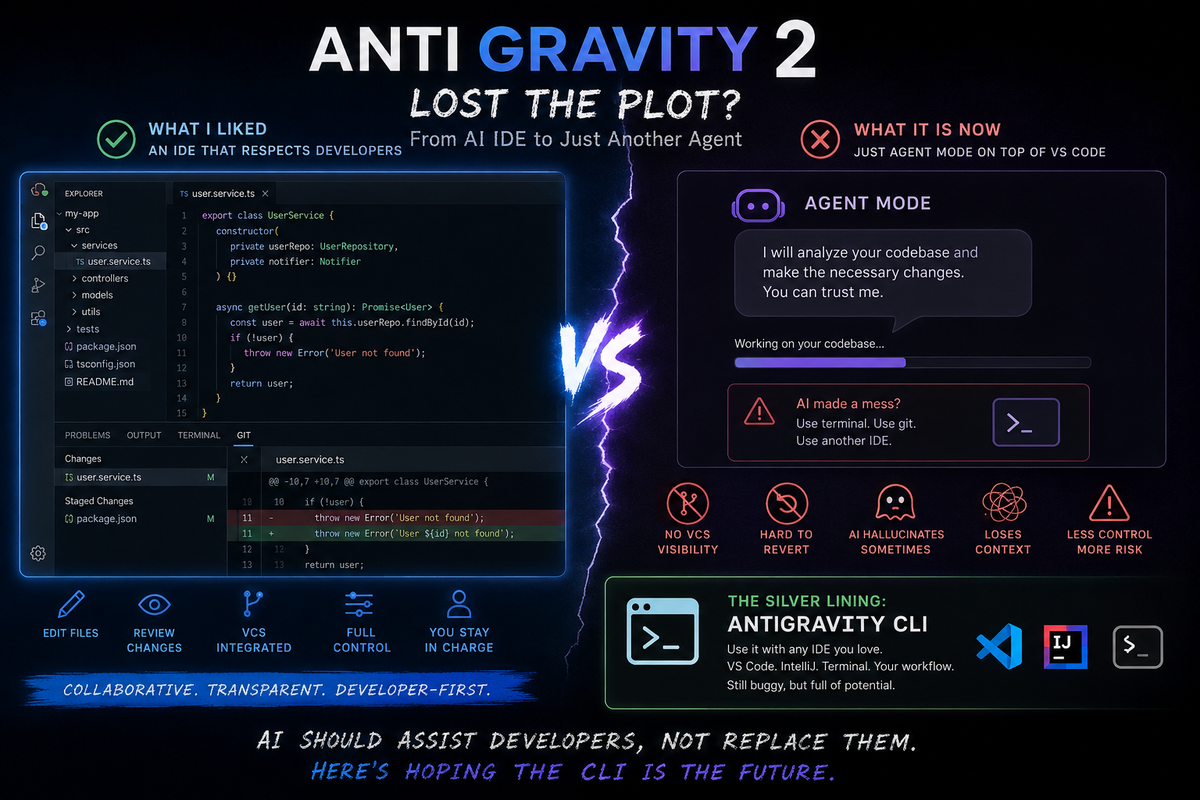
When I first started using AntiGravity, it felt like one of the most promising AI coding tools out there.
Not because it had the smartest models.
Not because it had the fanciest UI.
But because it understood something important:
Developers still want control.
It was basically a better VS Code experience with integrated AI, access to multiple free models, and enough flexibility to fit into an actual development workflow. It respected the fact that coding is not just prompting an AI and praying the output works.
Then AntiGravity 2 happened.
And honestly, I think they completely shifted away from what made the product good in the first place.
It’s Not Really an IDE Anymore
The latest version feels less like an editor and more like a dedicated “agent mode” from VS Code.
That’s the biggest issue.
I don’t want an AI that blindly edits my entire codebase while I sit back and watch. I still want to manually inspect files, review changes carefully, tweak logic myself, and understand what is happening in my project.
Because AI still hallucinates.
A lot.
And when it hallucinates inside a real project, the cleanup usually takes longer than writing the code manually in the first place.
That’s why developers rely on traditional IDE workflows:
- reviewing diffs
- selectively accepting changes
- debugging manually
- editing code directly
- reverting broken implementations quickly
AntiGravity 2 feels like it assumes developers should fully trust the AI agent.
I don’t.
And I don’t think most experienced developers do either.
The Missing VCS Integration Makes Things Worse
One of the strangest decisions is the lack of proper VCS workflow visibility in the new experience.
If the AI completely messes up your project now, your recovery options become awkward:
- open terminal manually
- run git commands yourself
- switch back to another IDE
- inspect files outside the workflow
That breaks the entire experience.
An AI coding tool should make version control more visible, not less.
Good AI tooling should encourage:
- safer experimentation
- transparent edits
- reversible changes
- confidence while coding
Instead, AntiGravity 2 feels optimized around autonomous generation rather than collaborative development.
AI Should Assist Developers Not Replace the Editor
There’s a growing trend in AI tools where companies assume developers want to stop coding entirely and become “prompt managers.”
I think that’s a misunderstanding of why people enjoy software development.
Most good developers want:
- speed boosts
- repetitive task automation
- faster debugging
- smarter autocomplete
- better refactoring assistance
But they still want ownership over the code.
The best AI tools are the ones that stay out of your way and integrate naturally into existing workflows.
That was AntiGravity’s original strength.
Ironically, by trying to become more autonomous, it became less useful for people who actually care about engineering quality.
The Silver Lining: AntiGravity CLI
There is one genuinely exciting part of this update though:
The new AntiGravity CLI.
This might actually be the smartest thing they released.
Why?
Because now you can use the AI with whichever IDE you already prefer:
- Visual Studio Code
- IntelliJ IDEA
- Android Studio
- terminal workflows
- custom setups
That’s a far better direction in my opinion.
Instead of forcing developers into a fully AI-controlled environment, the CLI approach lets AI become a flexible layer on top of existing workflows.
Right now the CLI is still buggy, rough around the edges, and clearly early-stage.
But I actually have more hope for its future than the IDE itself.
Especially because alternatives like Gemini CLI were honestly disappointing for real-world development use.
Final Thoughts
AntiGravity 2 feels like a classic case of a product moving away from the people who originally liked it.
The old version felt developer-first.
The new version feels AI-first.
And those are not the same thing.
AI coding tools work best when they enhance existing workflows instead of trying to replace them completely.
Maybe AntiGravity eventually finds the balance again.
But right now, the CLI ironically feels more promising than the main product itself.